

Why This Gets Under My Skin: What Emotional Triggers Are Really Telling You

A reflection on relationships, addiction, and the moment a protective pattern takes over.
A personal exploration of emotional triggers in relationships—and how to tell whether a reaction is warning you about the present, reopening an old wound, or revealing a hidden part of yourself.
“Unfollow.”
The image of my ex-husband sitting there smiling, drinking coffee and dispensing words of wisdom on his morning social media post was too much.
I couldn’t take another morning of it. So I unfollowed him. It has been more than six years now. Sounds a little unhinged? Maybe a bit of an overreaction? At the time, I didn’t have words for what I was experiencing.
As I prepared for a workshop on emotional triggers, I began reflecting on the longest relationship I’ve had - my marriage. We were together for twenty years, so you’d think there would be plenty of triggers to examine or use as case studies.
I was drinking heavily back then, and I can see now how often I used alcohol to bury what I couldn’t bear to feel. By the time I began studying depth psychology, I understood that many of my triggers were attached to feelings I had spent years avoiding. The warning bells had always been there; I simply couldn’t hear them through all the noise.
Because of that, I think the clearest example of a trigger came after we had already separated. Without the anesthesia of alcohol, I began to actually feel what was happening. And I didn’t know what was happening to me.
After we separated, my ex started posting a casual morning video series over coffee. The topics were not the point. What got under my skin was the sight of him sitting in his armchair, still in his robe, drinking coffee and speaking so warmly, openly and easily.
Over coffee.
I know. You’re thinking, “What’s the big deal?” But this is one way triggers work: the intensity can feel completely out of scale with what a camera would have recorded. If you described the situation to a stranger, they would probably shrug.
Because it doesn’t seem like much.
But my experience at home had been, “Don’t talk to me until I’ve had my coffee.”
And because context really matters here - I was frequently very hungover. Struggling to piece together how the night had ended, I would tiptoe out of the bedroom and find him in his armchair nursing black coffee. I’d search his face for evidence that everything was okay. There were plenty of mornings when I would not have wanted to talk to me either.
When I saw the posts, I was indignant at the incongruity between my experience of him and the person he presented onscreen. That’s what my ego told me I was angry about. But the deeper trigger was much more interesting.
I found some truths I had been avoiding when I turned the question around and asked, “Why did I choose him?”
There were good reasons. He was handsome, charming, outgoing and just the best guy I knew. Seriously. But he also represented many things I aspired to be. Instead of becoming them, I let him carry them for me.
Years later, I finally saw that the trigger was pointing toward something I had never given myself permission to live - a part he lived easily.
Ouch.

Being Upset Is Not the Same as Being Emotionally Triggered
We use the word “triggered” so casually now that it can mean almost anything: offended, annoyed, challenged, inconvenienced or simply disagreed with.
But a trigger is more specific.
Something happens, and the reaction often begins before you fully understand what you are reacting to. Your defensive system shifts into action. Meaning gets assigned. And a protective response takes over.
Someone says something uncomfortable and you feel off balance. Your head is reeling, as though the room tilted to one side and you’re the only one who noticed.
All the while, you watch yourself as if from outside - talking faster, over-explaining and hearing words come out of your mouth while your brain is still trying to compute what you even said. Or maybe you pursue - or withdraw. Do you become pleasing, punishing, controlling, invisible or impossibly reasonable? We have all kinds of defenses designed to keep us “safe.”
It may be days, weeks - or in my case, years - before you understand what you were reacting to. By then, your reaction may have already made some decisions for you.
That doesn’t mean the reaction is necessarily irrational. It means the present may have touched an older wound, and not everything you are reacting to belongs to what is happening now.

You don’t have the reaction. The reaction has you
Carl Jung did not use the term “trigger” in the way we use the word today. His theory of the feeling-toned complex, however, offers one of the clearest descriptions I have found of what it feels like to be overtaken by one.
A complex is not simply a memory. It is an emotionally charged constellation of memories, expectations, images and meanings organized around a particular wound or theme. We feel it in the body, and once activated it can behave with surprising autonomy.
We like to believe we are making a choice. In the activated moment, an older pattern may be making the choice for us.
This is why a relatively small event can produce an enormous response. The present moment has touched something much larger than itself. The partner who glances at a phone becomes every person who has ever dismissed you. The boss who questions one decision becomes the father you could never please. The unwashed dish becomes proof that you are alone, unimportant and carrying everything again.
The reaction is happening now, but not all of it belongs to now.
Something happens → the defensive system responds → meaning gets assigned → a protector steps forward → a reaction follows.
Much of this can happen rapidly, before reflective thought catches up. The meaning can feel like an observable fact:
“He doesn’t care about me.”
“She’s trying to control me.”
“I’m about to be abandoned.”
“I’m failing.”
“I’m not safe.”
The feeling is real. The interpretation may be partly accurate - or inherited from another time.
The trigger is the bell - not the verdict.
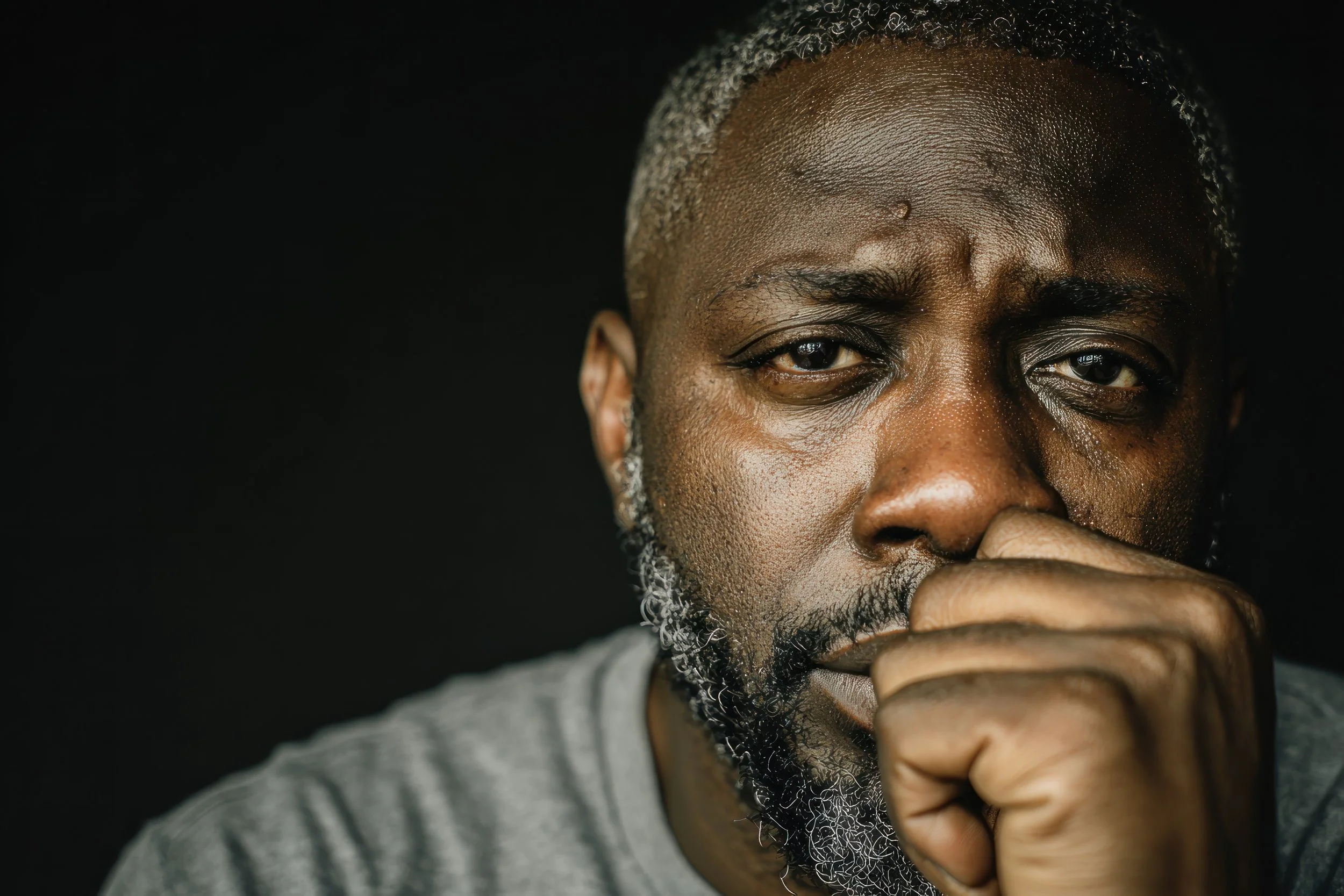
Why Emotional Triggers in Relationships Get Under Our Skin
For me, relationships are the clearest mirrors we have. Not just romantic relationships, but friendships and professional relationships can provide unique insight into ourselves too.
Jung understood dreams as symbolic expressions of the psyche while we sleep. Relationships can do something similar in broad daylight. They bring our unexamined expectations, unlived desires and oldest protective strategies into contact with another human being who has expectations, desires and defenses of their own.
It is not surprising that we trigger one another. Relationships provide another path into the unconscious because they often reveal what we deny ourselves.
Psychoanalytic theory calls one version of this projection: attributing to someone else - feelings, motives or qualities that are difficult to recognize in ourselves.
That does not make every relationship problem a projection. Sometimes people really do lie, withdraw, manipulate, drink, betray an agreement or refuse repair. Insight should never be used to talk someone out of what is actually happening.
Relationships activate the attachment system with particular force because closeness raises the stakes. Research by Mario Mikulincer, Phillip Shaver and their colleagues describes two common secondary strategies when connection feels threatened. Hyperactivation intensifies the signal: pursuing, escalating, clinging, demanding or scanning for evidence of rejection. Deactivation suppresses it: withdrawing, minimizing, shutting down or insisting that nothing is needed.
Neither strategy is a character defect. Each is an attempt to manage threat and regain a sense of safety.
In relationships, one person’s protection often becomes the other person’s trigger. The more one pursues, the more the other withdraws. The more one withdraws, the more the other escalates. Soon both people are reacting to the protection rather than responding to the person.
The original issue gets buried under the survival strategy.

The Relationship I was Repeating
When I looked more closely at what my ex represented to me in that post, the trigger became less random.
He has outgrown his worst ways, but growing up, my father was an angry alcoholic. His job required a lot of travel that kept him away for a week and home for a week. I was thankful during the weeks he was gone.
His return was like a dark cloud moving over the house. On any random school morning, I’d find my mother sobbing in the dark living room, still waiting for him to come home from the night before. I’d tell her it was “okay to leave.”
That may have been the beginning of my coaching practice: a child trying to help his mother solve a relationship he was powerless to change.
Looking back, I realize he must have had a lot of triggers himself, because when something wasn’t “right,” he would rage: “If you’re not going to do something right, don’t do it at all!”
It still echoes in my ears. I cannot know what that sentence meant in his own history. In my body, it became a hidden rule:
“Be perfect - or be invisible.”
When he was home, invisibility reduced the chance of becoming a target. Perfection promised safety.
Those skills kept me safe for a long time. Then I met someone who was everything I was faking, and I fell in love. He was charming, funny and handsome. He literally sang and danced for a living, which requires a sheer force of will that few people have.
While I hid behind the camera at work, he put himself onstage, knew where his light was and hit his marks. He pursued his career with singular dedication and received standing ovations for doing what I would never have dreamed I could do myself.
He would also blow up like my father - loud, direct and over quickly for him. I might remain shaken for a week, feeling justified in numbing the pain he had inflicted with another bottle of wine.
I am not blaming him. And I’m not reducing our whole relationship to this pattern. His experience of our relationship is his own. We affected each other. We wounded each other. We also loved each other.
Understanding my pattern does not erase what hurt. It helps me distinguish what is mine to work with from what is no longer mine to carry.
The relationship allowed me to re-enter a familiar emotional world: anticipation, anxiety, vigilance, admiration and fear. Part of me was carrying old expectations from my relationship with my father into my relationship with my partner. Old relational patterns can return when someone evokes a familiar combination of admiration and fear.
I had assigned him the job of living the visible, expressive life I had exiled myself from while I stayed “perfect and invisible.” No wonder I was conflicted.
So it wasn’t only “Coffee Talk” that set me off. Some of my anger belonged to what had happened between us. But most of it was pointing back toward me.
The performer in him irritated the hidden performer in me. What looked like resentment was also envy. The person “under my skin” was the part of me I had not yet reclaimed.

Three Messages an Emotional Trigger May Be Carrying
This is where discernment matters. A trigger is not proof that the other person is wrong. It is not proof that you are “too sensitive.” It is information, and that information may point in more than one direction.
1. A boundary alarm
Something harmful, disrespectful or incompatible may be happening now. Your anger may be telling you that an agreement has been broken. Your dread may be registering a pattern your conscious mind keeps excusing. Your shutdown may follow repeated attempts to speak that have gone nowhere.
Some triggers ask us to examine ourselves. Others ask us to stop participating. Self-inquiry does not require self-abandonment.
Ask: What am I tolerating?
2. An old wound
The present event may resemble an earlier experience closely enough to activate the same protective system. The person in front of you is not your father, your ex or the kids who humiliated you at school. But your defensive system may respond as though the earlier pattern is repeating.
Ask: What is real?
3. A shadow signal
The other person may be expressing a quality you learned to reject in yourself. Their confidence feels arrogant because you disowned your authority. Their need feels unbearable because you buried your own. Their visibility makes you cringe because you are hiding. Their freedom looks selfish because you were trained to earn love through sacrifice.
Ask: What am I avoiding?
In Jungian terms, the shadow does not hold only what we consider ugly about ourselves. It can also hold vitality, creativity, anger, ambition, sexuality, authority and desire that did not feel safe to feel or express.
A trigger may carry more than one message at once. My ex’s posts challenged me to admit what I really wanted and that it wasn’t him holding me back.
From reaction to choice
The Trigger Map I use in my coaching draws on Jungian inquiry, relational responsibility and a movement I call the Roadmap to Self-Rule.
A trigger may explain your behavior, but it does not excuse its impact. The other person may have activated an old wound and still deserve a boundary. You may have been genuinely hurt and still owe an apology for what you did next. Mature relationship work asks us to tell the truth, own our behavior and repair what can be repaired.
The Roadmap helps us locate our present relationship to choice and recognize what becomes possible from here:
“Fuck Me”: I collapse into the pattern. It is happening to me, and I cannot yet see an alternative.
“Fuck This”: I recognize the pattern. Something has to change.
“Fuck Off”: I separate from what is not mine, defend a boundary and interrupt the old agreement.
“Fuck Yeah”: I integrate the lesson and choose from a fuller self.
The movement is not always linear. We can recognize a pattern in one moment and collapse back into it in the next. But once we have seen it, we have somewhere to return.
Eventually, we have to get out of the courtroom of either/or. The other person may have behaved badly, and my reaction may carry old material. My protective system may be trying to help me, and its prediction may be outdated. I can understand why I reacted and take responsibility for the consequences. I can love someone and leave.
I can set a boundary without turning the other person into a villain. This is not a spiritual bypass around conflict. It is the capacity to hold complexity without abandoning truth.
Slow the sequence down
The practical challenge is that none of this reflection is easily available at the peak of activation. You cannot perform a Jungian analysis while your nervous system believes the building is on fire.
First, interrupt the sequence.
Dialectical Behavior Therapy uses behavior-chain analysis to examine vulnerability factors, the prompting event, thoughts, sensations, emotions, urges, actions and consequences. The method is powerful because it replaces “I just lost it” with a sequence that can be observed.
The Trigger Map follows a similar chain, then adds archetypal and relational questions:
1. What made me vulnerable? Was I tired, hungry, hungover, lonely, ashamed, already stressed or waiting for reassurance?
2. What would a camera have recorded? Separate the prompting event from the story your inner narrator immediately told about it.
3. What happened inside me? Notice the bodily sensations and the meaning you assigned. What did the moment seem to prove about you, the other person or the relationship?
4. What hidden rule - and which protector - took over? Be perfect. Stay invisible. Do not need. Do not fail. Do not let them leave. Never be controlled. Who pursued, attacked, performed, disappeared, rescued, controlled or shut down?
5. What did I do next, and what did it cost? Name the behavior, its short-term payoff and its longer-term consequence.
6. What truth is the trigger carrying, and what is my next sovereign move?
Boundary alarm, old wound, shadow signal - or some combination? Pause. Ask a question. State a boundary. Make a repair. Leave the room. Tell the truth. Reclaim the quality you projected onto someone else.
When you recognize the pattern sooner you can meet the activated part of yourself from a steadier place, “I see you. I understand what you’re protecting. But you don’t have to make this decision alone.”

Epilogue: Now I’m the One Onstage
What changed? I tossed out an identity built around being perfect and invisible and started over. I became a coach. I began writing, teaching, making videos and leading workshops with my own face and voice out front.
Now I’m the one onstage.
I stopped asking someone else to perform the life that was waiting. The trigger was the invitation back to myself.
Explore your own Trigger Map
Join me for Why This Gets Under My Skin, a live online 90-minute workshop on August 11, 2026, at 6:30 p.m. Mountain Time.
We will slow down one real trigger, separate what happened from what your protective system predicted was happening, identify the protector that took over and find a more sovereign next move.
This is not about excusing harmful behavior, blaming your childhood or forcing forgiveness. It is about turning activation into information, choice and action.
You can also take the Trigger Map quiz to begin identifying the pattern your reactions follow.
This article is educational and reflective. It is not a diagnosis or a substitute for mental-health treatment. If triggers involve trauma symptoms, dissociation, self-harm, substance use or a threat to your safety, consider working with a licensed mental-health professional.
Research and further reading
For readers interested in the thinking beneath the Trigger Map:
- C. G. Jung, [“A Review of the Complex Theory”](https://iaap.org/resources/academic-resources/collected-works-abstracts/volume-8-structure-dynamics-psyche/), in The Structure and Dynamics of the Psyche, Collected Works, Vol. 8.